
Welcome to the iPrepBuddy Monthly Newsletter!
Stay informed with the latest updates on our platform and the newest advancements in ophthalmology. This newsletter aims to keep you prepared for your upcoming exams.
by Dr Chloe Walugembe on 01/09/2026
Clinical Insight: Fuchs’ Endothelial corneal dystrophy
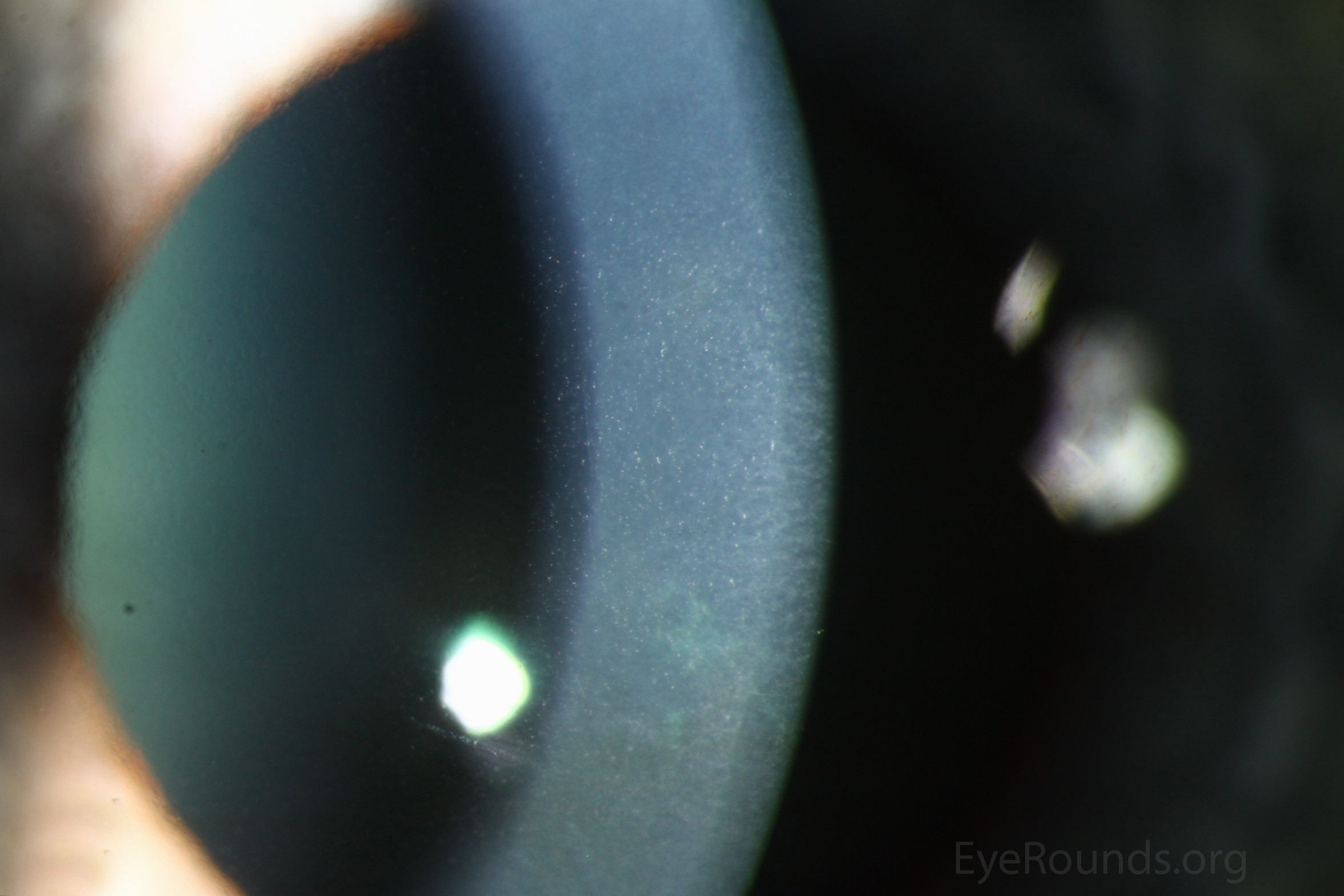
Guttae, are excrescences of collagen produced by stressed corneal endothelial cells. They can have a dimpled or "beaten metal" appearance at the slit lamp [1].
Fuchs endothelial dystrophy is a progressive, bilateral corneal disorder in which endothelial cell loss leads to guttata formation, fluid retention and eventual vision impairment; it's one of the leading indications for endothelial keratoplasty. It typically affects adults over 50 and is more common in women, with genetic predisposition (notably the TCF4 trinucleotide repeat expansion) a key risk factor. Diagnosis is clinical, based on slit-lamp findings of guttata and in advanced disease, stromal oedema and bullae. Management has shifted from full-thickness penetrating keratoplasty toward selective endothelial transplantation (DSEK, DMEK), which offers faster recovery and better graft survival [2].
Platform Updates
We hope everyone is enjoying the new website updates!
Remember that we have now introduced virtual part 2 viva evenings - these are ad hoc hour long sessions in small groups for those who have subscribed to part 2 on the platform
We hope later this year to run a fully virtual course to complement the AI part of the platform.
We are actively collaborating with colleagues in building technology supported educational modules, if anyone has a workshop or idea they’d like to build around, reach out to us!
Updates in Ophthalmology
1. £20m Digital Referral Boost to digitise referrals from the high street directly into NHS hospital eye services
The government has announced £20 million to digitise referrals from community optometry practices directly into NHS hospital eye services, giving every NHS-contracted optical practice in England access to the NHS e-Referral service and National Care Records Service by April 2028. The aim is to cut unnecessary hospital trips, reduce pressure on GPs and support more accurate onward referral [3].
2. Optogenetics — restoring vision without fixing the mutation
Optogenetics is an emerging gene-therapy approach that aims to restore vision in advanced retinal degeneration by making surviving retinal neurones sensitive to light, rather than correcting the underlying genetic mutation. A study investigated an engineered synthetic opsin delivered using an AAV2 vector to surviving bipolar cells. In four patients with severe retinal degeneration, treatment was associated with improvements in visual function, shape discrimination and mobility over 52 weeks, suggesting that optogenetics may offer a mutation-independent approach to restoring useful vision. However, larger controlled trials are needed to establish its long-term efficacy and safety [4].
3. Role of light in eye growth and light as a therapy for myopia control
Growing evidence suggests light itself helps shape how the eye develops, with researchers increasingly linking factors like light intensity, wavelength and daily exposure patterns to myopia risk in children. A recent Frontiers in Ophthalmology review report that children who spend more time outdoors tend to develop myopia less often. The paper also highlighted the benefits of low-level red-light therapy as one of the more promising interventions for slowing eye elongation [5]. A 2024 randomised trial (Cao et al., JAMA Ophthalmology) offers early support for this: 336 children were given daily red-light sessions over a year showed substantially less axial elongation than those without treatment and no safety issues emerged over the study period [6].
Upcoming Conferences
Upcoming conferences:
British & Irish Paediatric Ophthalmology Conference British Emergency Eye Care Society (BEECS) - 17th-18th Sep | Birmingham
United Kingdom &Ireland Society of Cataract & Refractive Surgeons (UKISCRS) – 19th-20th November 2026 | London
World Society of Paediatric Ophthalmology & Strabismus Conference — 11 Sep | London
British & Irish Paediatric Ophthalmology Conference — 30th Sep–2nd Oct | Liverpool
World Society of Paediatric Ophthalmology & Strabismus Conference — 11th Sep | London
Regional meetings:
Cambridge Ophthalmology symposium - 3rd-4th Sep | Cambridge