
Welcome to the iPrepBuddy Monthly Newsletter!
Stay informed with the latest updates on our platform and the newest advancements in ophthalmology. This newsletter aims to keep you prepared for your upcoming exams.
by Dr Chloe Walugembe on 01/06/2026
Clinical Insight: Polypoidal choroidal vasculopathy (PCV)
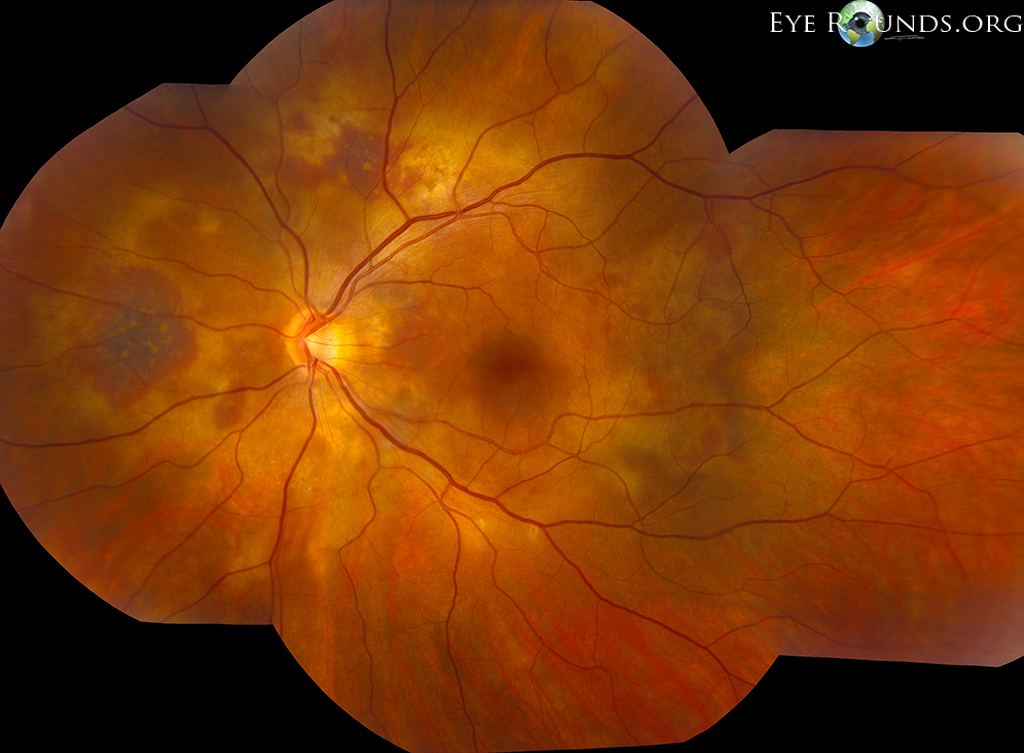
Figure 1: Multiple foci of subretinal haemorrhage surrounded by yellow subretinal deposits consistent with old haemorrhage. Images courtesy of eyerounds.org
Polypoidal Choroidal Vasculopathy (PCV) is characterised by recurrent serosanguinous RPE detachments arising from an abnormal choroidal vascular network. Patients typically present with blurred vision, central or paracentral scotoma, or dim vision. Indocyanine green angiography (ICGA) remains the gold standard for differentiating PCV from other neovascular conditions. Management options include observation, photodynamic therapy, intravitreal anti-VEGF, or combination therapy. These patients will be followed up closely to detect and prevent subretinal and sub-RPE fluid and haemorrhage [1] [2].
Platform Updates
We want to collect some feedback from our users to know how we are doing and what we can do to improve.
Please use this link to leave us feedback (https://forms.gle/4DQq5HUbz573mBG7A)
Updates in Ophthalmology
1. Bionic Retinal Microchip Restoring Reading Vision in AMD
Geographic atrophy (GA) secondary to AMD affects over five million people worldwide, with no available therapy to restore lost vision. The PRIMAvera trial evaluated the PRIMA subretinal photovoltaic implant in 38 participants with GA and severely reduced visual acuity. At 12 months, 81% achieved a clinically meaningful improvement of ≥0.2 logMAR, with peripheral vision preserved throughout. Serious adverse events occurred in 19 participants, most resolving within two months of surgery. This represents the first evidence of meaningful central vision restoration in GA [3] [4].
2. The retinal age gap: a window into systemic health in schizophrenia
The retinal age gap (RAG) — the difference between predicted retinal age from fundus photography and chronological age — is emerging as an oculomic biomarker for accelerated biological ageing. A recent study by Antaki et al. found that the larger RAG observed in patients with schizophrenia was primarily driven by hypertension and diabetes mellitus rather than schizophrenia itself, redirecting focus toward modifiable metabolic co-morbidities - likely compounded by antipsychotic side effects. If validated longitudinally, the RAG could function as a Framingham-style risk score, enabling rapid, non-invasive identification of patients requiring more intensive metabolic management [5].
3. Clinical trial data found no significant link between GLP-1 receptor agonists and progression of diabetic retinopathy, despite recent speculation
A systematic review and meta-analysis of 39 studies found no significant association between GLP-1 receptor agonist use and the development or progression of diabetic retinopathy (RR 1.00, 95% CI 0.71–1.43), with consistent findings across RCTs and observational studies. A non-significant trend toward reduced retinopathy risk was noted in RCTs. The authors conclude that current evidence does not support an increased risk, though long-term ocular safety data are still needed [6].
4. The first disease-modifying treatments for geographic atrophy
Pegcetacoplan (Syfovre) and avacincaptad pegol (Izervay) were approved by the FDA in 2023 - the first disease-modifying treatments for geographic atrophy - neither is available to NHS patients. A study done on pegcetacoplan in 2025 demonstrated up to 45% reduction in GA lesion growth over 30 months, whilst avacincaptad pegol showed comparable efficacy in the GATHER trial [7] [8]. Unfortunately one of the main risks is the conversion to neovascualr AMD [7] [8]. For a condition affecting 600,000 people in the UK with no alternative treatment, this could represent a potential new management option.
Upcoming Conferences
Upcoming conferences (Upcoming abstract deadline):
British & Irish Paediatric Ophthalmology Conference British Emergency Eye Care Society (BEECS) - 17th-18th Sep | Birmingham
Abstract deadline: 30th June 2026
United Kingdom &Ireland Society of Cataract & Refractive Surgeons (UKISCRS) – 19th-20th November 2026 | London
Abstract deadline 1st August
Upcoming conferences (Abstract deadline passed):
Infectious Keratitis Ocular Network Conference - 4th June | London
British & Irish Paediatric Ophthalmology Conference — 30th Sep–2nd Oct | Liverpool
World Society of Paediatric Ophthalmology & Strabismus Conference — 11th Sep | London
Regional meetings:
Oxford Ophthalmological Congress - 6th-8th July | Oxford
Cambridge Ophthalmology symposium - 3rd-4th Sep | Cambridge