
Welcome to the iPrepBuddy Monthly Newsletter!
Stay informed with the latest updates on our platform and the newest advancements in ophthalmology. This newsletter aims to keep you prepared for your upcoming exams.
by Dr Chloe Walugembe on 1/05/2026
Clinical Insight: Vernal keratoconjunctivitis (VKC)
(With hay fever season well underway, this felt like a timely condition to cover this month!)

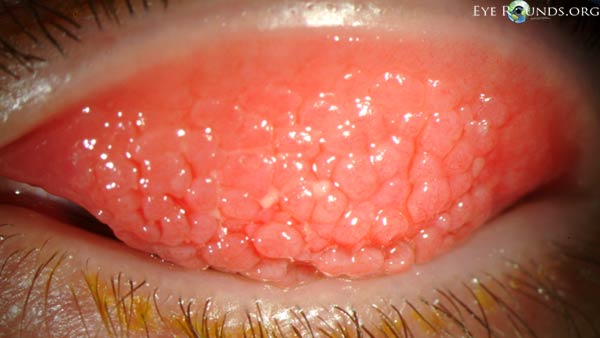
(Top) Limbal vernal keratoconjunctivitis showing Horner-trantas dots [1]. (Bottom) Conjunctival/ Palpebral vernal keratoconjuncitivitis showing cobblestone-like giant papillae on the upper tarsus[2].
VKC is a seasonal disorder, predominantly seen in male children with a history of atopy and from african or asian descent. It is a IgE mediated response with eosinophils also playing a significant role. Pts present with itchy eyes, photophobia, mucoid discharge and foreign body sensation. VKC signs can be divided into 3 main categories:
Conjunctival VKC: Presents with diffuse papillary hypertrophy most prominent on the upper lid.
Limbal VKC: Presents with Horner-Trantas dots (raised limbal eosinophilic deposits) and can lead to limbal stem cell deficiency.
Corneal VKC: Can present with keratitis, shield ulcers and in extreme cases pseudogerontoxon [3].
Mx: In mild cases cold compresses, lubricants, topical antihistamines/mast cell stabilisers and in moderate cases it is tx with topical corticosteroids, ciclosporin 0.05-2% or tacrolimus.
Platform Updates
The ST1 module now features 40 scenarios.
The New FRCOphth Part 2 Oral scenarios are up
Please don’t hesitate to reach out if you experience any difficulties with the platform or have feedback to share- we are here to help!
Updates in Ophthalmology
1. Increased risk of Non-arteritic Anterior Ischaemic Optic Neuropathy in semaglutide users
NAION is the second most common optic neuropathy after glaucoma and typically presents as sudden, painless, monocular vision loss accompanied by optic disc oedema. Emerging evidence has raised safety concerns regarding semaglutide and an increased risk of NAION. In one study done by Kai Yang Chan et al. it found that semaglutide users were 2.62 times more likely to develop NAION [4]. Similarly in another study looking at T2DM semaglutide users they had a 4.3-fold increased risk of NAION; in overweight/obese patients, the risk was even higher at 7.6-fold [5].
2. Moorfields new treatment for chronic hypotony — world-first pilot series
In January 2026, Moorfields published the first pilot series evaluating the use of intravitreal HPMC as a treatment for chronic hypotony - a condition that remains difficult to manage with current available options. It showed encouraging results: 87.5% of patients demonstrated improved BCVA and raised IOP, with axial length increasing in 75% of treated eyes [6]. Hear about this new treatment directly from a patient within the study [7].
3. Moorfields Hospital and UCL develop AI tool to predict eye damage from autoimmune drug
Moorfields Eye Hospital and UCL have developed HCQuery, an AI algorithm that predicts hydroxychloroquine retinopathy up to 2.74 years before current screening methods. Trained on over 8,000 OCT scans from 409 patients, the tool achieved 100% sensitivity in identifying retinopathy and 91% specificity in ruling out disease. Hydroxychloroquine retinopathy affects up to 7.5% of users and causes irreversible retinal damage, but current screening only begins after five years of use. The algorithm's code is publicly available on GitHub to encourage further development and testing [8].
4. NHS cataract tariff cut 20% from 1 April
From 1 April 2026, prices paid to cataract surgery providers will be cut by 20%, with most of the savings redirected to more complex ophthalmology care. The RCOphth welcomed the decision, stating that over-incentivising cataract surgery had diverted huge resource away from more clinically urgent conditions [9].
Upcoming Conferences
Upcoming submission deadlines:
British Emergency Eye Care Society (BEECS) - 17th-18th Sep | Birmingham
Abstract deadline: 30th June 2026
Infectious Keratitis Ocular Network Conference - 4th June
Abstract deadline: 1st May 2026
Regional meetings:
Oxford Ophthalmological Congress - 6th-8th July | Oxford
Cambridge Ophthalmology symposium - 3rd-4th Sep | Cambridge
Abstract deadline passed:
British & Irish Paediatric Ophthalmology Conference — 30th Sep–2nd Oct | Liverpool
World Society of Paediatric Ophthalmology & Strabismus Conference — 11th Sep | London
RCOphth Annual Congress 2026 — 18th–21st May | Manchester